
Thoughts
〰️
Thoughts 〰️
I grew up on Barbie films, I’ve seen all the classics and still remember all the songs (I sometimes still play them while walking my dog and some of them legitimately get me crying every time cough-cough the cat’s meow cough-cough). I loved owning Barbie dolls, they were the toys I played with the most along my Monster Highs. It was an entire world of girls with just two token male dolls if I ever needed one ; a prince charming from Cinderella doll — with no legs because my grandmother’s dog had ripped them off— and a Eugene Fitzherbert (Flynn Rider for people with no memory, or Horace of the Dark Kingdom for those who have seen the TV show) — with legs but they kept coming out of their socket so it was a nightmare getting him to sit without dislocating his legs. However let’s be honest, I rarely ever used them.
Like everyone, I grew up, I had my phase when I didn’t want to be associated with pink because I didn’t want to be seen as basic — haha internalised misogyny, we love to see it — and now I’ve been throwing pink everywhere I can. However, I never had a phase when I hated Barbie. I never physically compared myself to her. To me she was a cartoon character, not a person I was meant to look like, and not me. Each Barbie had their own story and personality based on the outfit and face mold they had, none were supposed to be me. They were puppets for my show.
I saw a lot of the Barbie slander, and the way it was presented, I usually agreed with the point they were trying to make, but I never felt like I related to the issues they were raising. It was more like yes I agree this is an issue but at the same time I don’t really see it, but you do, and what you see is relevant so I’ll agree.
Due to this, I decided to look a bit closer at the source material while I was at uni, (a long time ago) and ended up doing a small study on Barbara Millicent Roberts as a good or terrible role model for children.
How the world sees Barbie
Honestly, before asking whether Barbie is a good role model, I think we need to ask a slightly different question: what does Barbie look like in people’s heads? Because in the end, it doesn’t matter much what the character actually does. What people retain of her, the image that pops up when you say the word “Barbie”, is what decides everything. Same reason as to why everyone says Ariel changed her entire personality and left her world for a man (our girl had been obsessed with human culture FOR YEARS, the dude was just an added bonus, a catalyst if you will).
So, even though it pains me to say it, when we say the word out loud, the first image you get in your head is probably not Barbie in her astronaut costume. You will picture the classic look: blonde, in pink, and slaying. Stereotypical Barbie, as they say in the film. That’s why they picked Margot Robbie (and she was perfect in it, I love the aesthetic of that film you have no idea).
The best way to know how the world sees Barbie, is to see how her name is reused outside of Mattel’s control. People only borrow a name when they’re sure everyone will get the reference, and it’s usually not flattering.
Take music. Aqua’s Barbie Girl treats her as a full-on object, a doll you can dress up, pose and do whatever you please with.
“I’m a blond bimbo girl in a fantasy world
Dress me up, make it tight, I’m your dolly
[…]
Make me walk, make me talk,
do whatever you please”
She isn’t a person with opinions, she’s an object with a really catchy hook — cause yes, regardless of what the lyrics actually say, it’s a banger.
And yes, objectively Barbie IS a doll you can do whatever you want with. But the transposition to the lack of agency of an actual woman while borrowing the name of the doll is where the issue lies, and obviously something that contributed to Barbie’s reputation. Also fun fact: Mattel took it so badly that they tried to sue the label over the song, because of what it did to their branding. They lost on account of satire rights, which, fair enough.
Then there’s Avril Lavigne and Nicki Minaj’s Dumb Blonde, where “Barbie doll” stands in for idiocy.
“I ain’t no dumb blonde
I ain’t no stupid Barbie doll”
Blonde, empty-headed, nothing going on upstairs. The classic cliche of the ‘dumb blonde’ that has been perpetuated by Hollywood ever since, well, cinema started. Except now it had another modern face to show for it : Barbie’s.
Meghan Trainor’s All About That Bass does something a bit different.
“And no I won’t be no stick-figure, silicone Barbie doll
[…]
Go ahead and tell them skinny bitches”
It associates silicone Barbie dolls and skinny bodies with being a bitch, an association between physical appearance, plastic surgery and personality which is controversial in its own way. But again, Barbie isn’t used as someone you want to be, she’s the mean bitch who is plastic-fake. Literally.
So: the blonde in pink, the object, the idiot, the skinny bitch. Whatever the angle, everybody had a Barbie in their head, usually not under a pretty light.
Then the internet took her back
As time went on, a new wave started appearing. The Instagram account @trophywifebarbie plays on the image of Barbie by giving her extra weight and a glass of wine, to show a stereotypical but probably funnier, and maybe closer to the truth, version of moms. Use the name of Barbie, use a cliche-name (trophy wife) — which is another derogatory word for women that would probably be put in the same “you’re not a girl’s girl” category along with the Barbie women — and completely reverses it by instead showing pictures of a Barbie doll with ‘flaws’.
We were starting to see a duality in how Barbie is portrayed outside of Mattel.
The birth of Trisha Paytas’ daughter was probably the best example. Once it was publicly known that the little girl’s name would be Malibu Barbie, Twitter (or X) went wild. A user calling the name cunty (back then it wasn’t a compliment) while someone else called it iconic.
Same name, same doll, one insult and one compliment.
However, what I believe to be the most interesting thing in that GIVE US BARBIE’S IMAGE BACK YOU’RE ALL BEING TERRIBLE TO HER movement is that it actually had, and still has, two distinct sides.
The first one is the defensive version. No, she’s not like that, go watch the movies and educate yourself instead of spreading lies.
The second is louder: yes, she’s like that, and it’s awesome, what’s your problem?
You can see both in the numerous memes.
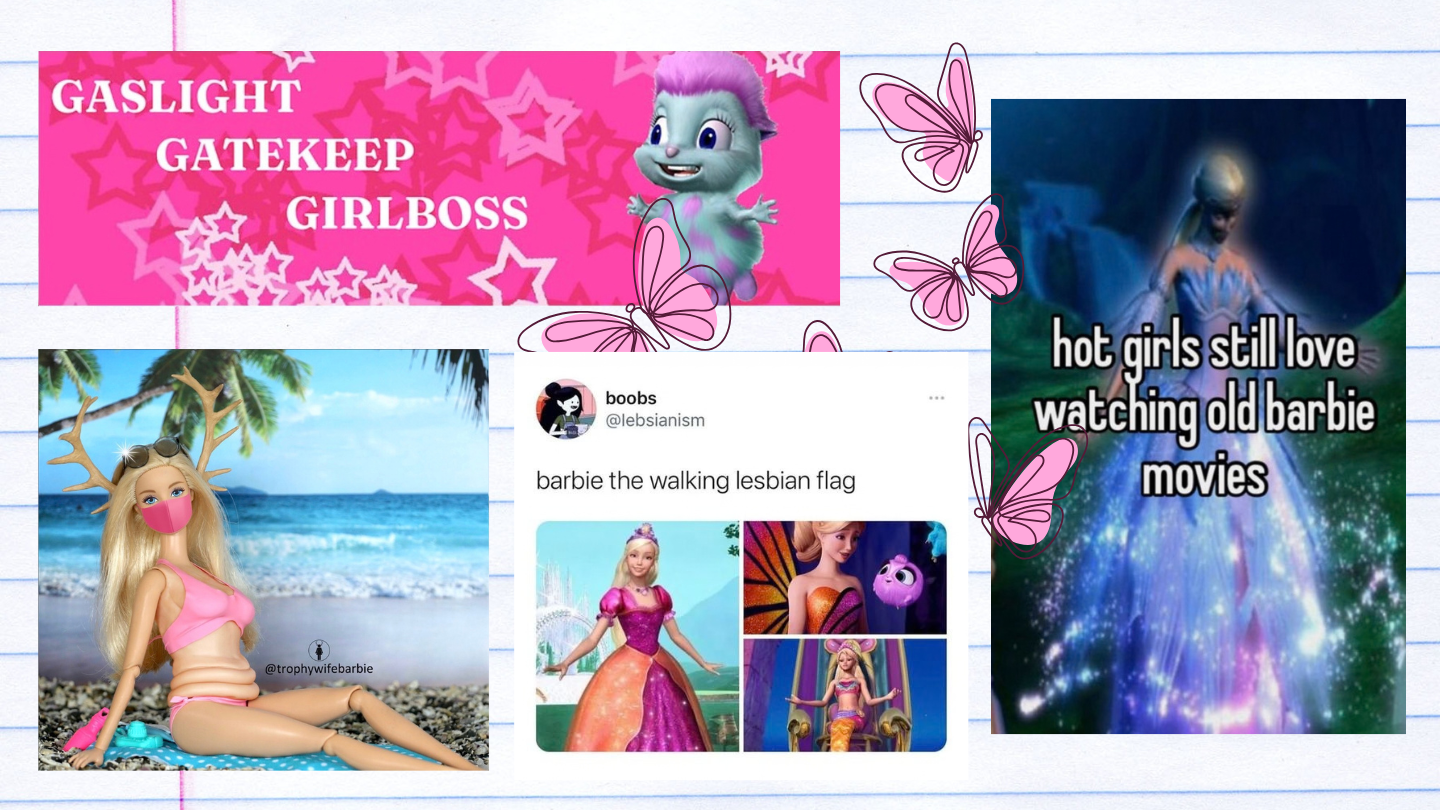
And that is the beauty of both sides. Because underneath all the memes, they force us to ask the real questions. They force us to actually look in the mirror and see what we have done to a doll just because it was blonde and good-looking.
Any depths given to her in the NUMEROUS films she is the main character of? Erased. Unless you’re a fan who knows your lore.
All that’s left is the blonde who only thinks about looks and shopping.
“only thinks” ?
Seriously?
Why is liking clothes or shopping automatically a sign that you have nothing in your head? And why would liking fashion, or liking looking nice, automatically be a bad trait that should be shamed? Especially in a society that CONSTANTLY rewards the people who make the effort. At every corner you’ll subtly, and not so subtly, tell girls and young women that appearance matters, yet whenever a character likes to look nice because it makes them smile, you’re going to shame them for it?
At this point it’s not about Barbie, it’s about the internalised misogyny we all need to take a closer look at. Along with the awful mixed signals we send to children still forming their own self.
So that’s what we have done with Barbie’s image. But realistically, what has Mattel done?
The dolls
Obviously I have to start with the dolls, that’s where it all came from. I won’t bother telling you how Barbie was created and blablabla because a hundred posts have done that before me. It’d be redundant. I’d rather look at what they have done overall and how it evolved. They have a whole history to look at now, far beyond “The First Barbie”
Think of their official slogan, “You can be anything.” Mattel says there are over 200 Barbie careers if you count the clothing sets and playsets. I counted them myself, and as of 2022 I got 224. (I told you I made this article at uni, all of my sources are from 2022, I’m just re-working it for the blog because this was originally a presentation and like a mad-woman I didn’t write any notes, just my slides and sources)
The biggest category of all her careers is by far arts and media, with 56. Then sports and athletics with 43, and business with 38. Science and engineering has 18, and so do the “Others” roles that couldn’t fit into anything. Education and transportation have 12 each, medicine 11, military 7, public service 7. Politics comes last, with 5.
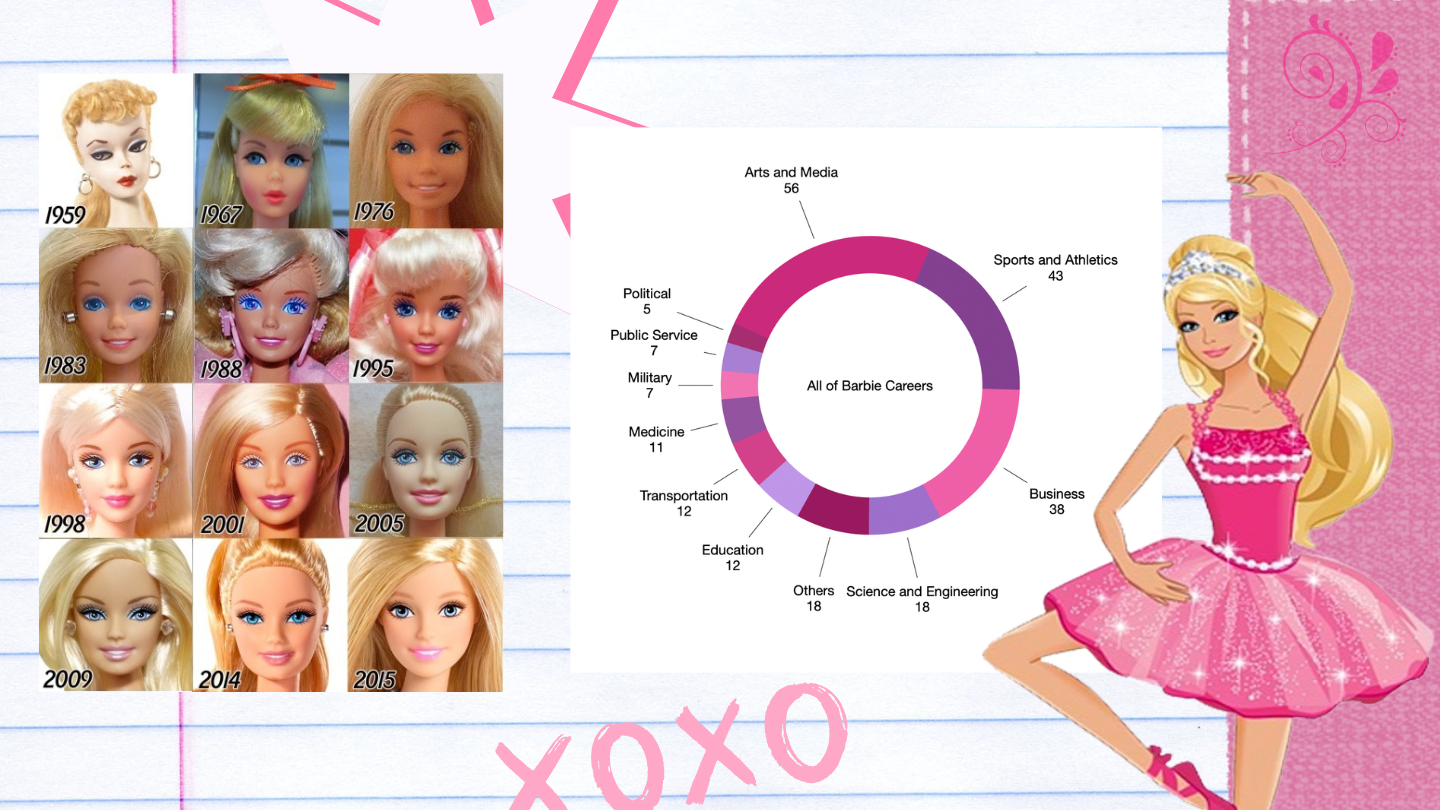
So yes, she really can be anything. She’s just mostly an artist or an athlete. But it makes sense in a way, when you’re a kid, that’s usually what you dream of being. Until the Art industry and Sport industry crush your dream, if your loved ones haven’t done so before by telling you “it’s not a real job”.
I won’t argue that Barbie wasn’t marketed to fit beauty standards. She was. Her facemold evolved over the years to fit what we considered appealing. The goal, obviously, has always been to sell. But I would say it must have an interesting side effect: everyone’s perception of Barbie might be based on a different face, and so on a different personality. Line up the faces from 1959 to 2015 and you’ll see what I mean. The Barbie your mother or grandmother remembers isn’t the one your little cousin has, nor the one you might have had.
I will admit, the timeline is more interesting than I expected. Probably my best part of this study. Barbie keeps a very close eye on the news.
She is an astronaut in 1965, four years before Apollo 11 actually lands on the moon. Girls had an astronaut Barbie before the moon landing.
Twiggy starts her modelling career in 1965, and in 1967 she gets her own Barbie, the first celebrity doll.
Christie, one of the first Black dolls, arrives in the late sixties, about a year before the end of the Civil Rights Movement in the US.
And in 1992, the year of a US presidential election, there is a Barbie President.
BUT!
Because there is always a but. Despite all the advocacy for young girls, we can’t ignore versions like Teen Talk Barbie. Also 1992, by the way, the same year as the President.
She was made to say things like “Math is hard!”, “I love shopping!”, “Will we ever have enough clothes?”, “Let’s plan our dream wedding!” and “The beach is THE place for the summer!”
Same brand, same year, same slogan about being anything. One Barbie can be president. The other finds maths difficult. People noticed, of course. A group called the Barbie Liberation Organisation swapped the voice boxes of Barbie and G.I. Joe dolls, so that dolls on shelves started saying things they hadn’t been programmed to say. And the Simpsons literally references it in one of their episodes.
It is obviously sad that the most famous time they made Barbie talk it was to say that she struggles with maths. But a small part of me cannot help to look at the entirety of the dolls, with so many different achievements, and wonder what is so wrong with one Barbie struggling with maths. Other Barbies are teachers, astronauts, scientists, presidents. Why can’t one Barbie struggle with maths? I know plenty of people who struggle with maths, boys and girls alike. Can’t they have representation too?
I feel like it is such a complicated debate, because what we promote towards young children is obviously INSANELY important, but we also need to consider how our reaction towards things they identify with might look. Maybe I am playing devil’s advocate or overthinking this, I’m not sure. I just feel like it’s hard to condemn a Barbie who loves clothes, shopping and the beach without ultimately condemning these traits as something horrible, even though they are traits plenty of people possess without it being enough to judge their character.
Anyway. Enough about the dolls. Because we can project whatever we want onto them and they really are more a reflection of ourselves and our own thoughts than anything else. Instead, let’s take a look at all the other times Mattel has made Barbie speak.
The screen
Let’s start with the TV series, Barbie: Life in the Dreamhouse. It’s greatly oriented towards comedy, but it still let Barbie be something she hadn’t been before: a woman with extreme facial expressions. I love the classic Barbie animated films, but her range of expressions in them stays quite poised. It fits the genre of an enchanted fairy tale meant to lull you, but the fact is her face didn’t move much.
Life in the Dreamhouse broke that. Yes, she is still a doll with perfect hair, but she can pull the funny face your best friend makes when you’re trying to be serious. And it’s no wonder so many excerpts of that show have become memes and screencaps are being used as reaction pictures.
Then the films.
They are constantly aimed at kindness, bravery and solidarity, and unlike Disney (which I love, don’t get me wrong), beauty is never mentioned as a quality. Yes, Barbie is objectively beautiful. But it is never her personality, and it is never what the film promotes, and it is never mentioned. The only time someone will mention Barbie’s beauty, it usually is a villain.
Instead the focus is on sisterhood and doing the right thing, and sometimes even quietly political plots. (Just watch the films, they’re great, I promise)
Also, I tested them. You’ve probably heard of the Bechdel test, named after the comic strip artist Alison Bechdel: two named women talk to each other about something other than a man. Plenty of people say that test is bs. Maybe it is. I still tried it. Every single Barbie movie passes it. 100%. And usually within the first three minutes, there are a few exceptions but it’s usually due to a song or due to Barbie living alone for a bit (think the island princess or space adventures).
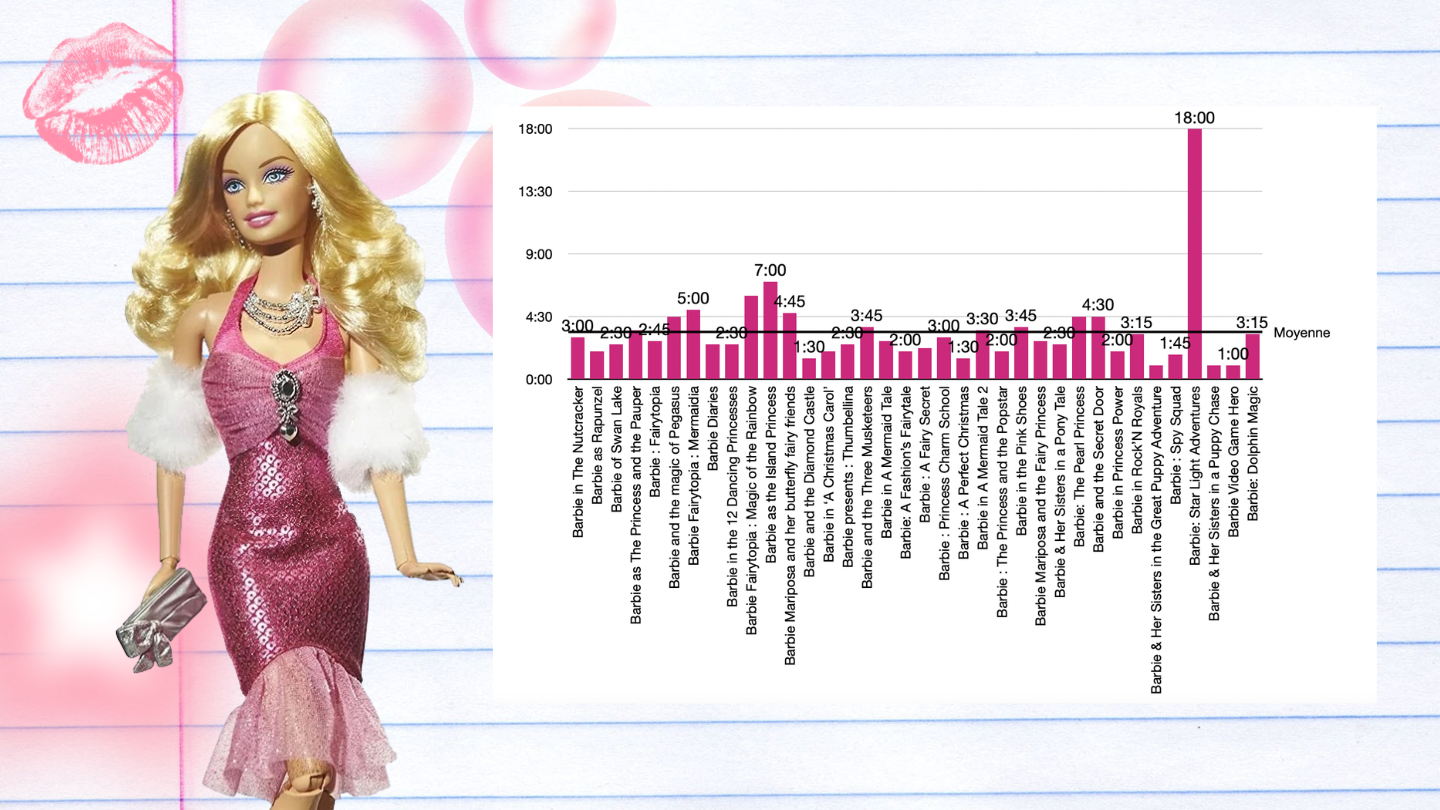
Which is not very surprising, to be honest. It’s a film about Barbie.
So I got curious, and I flipped it. The reverse Bechdel test: two named men talking to each other about something other than a woman.
This time, 80% of the films fail. Only about one in five passes, and some of those are borderline. Barbie and the Three Musketeers has a prince and his uncle talking about a crown. In Barbie: Mermaidia a kidnapped prince talks with a fungus (I’m still deciding whether that counts). And in Barbie and the Nutcracker, a mouse talks with a bat about the nutcracker.
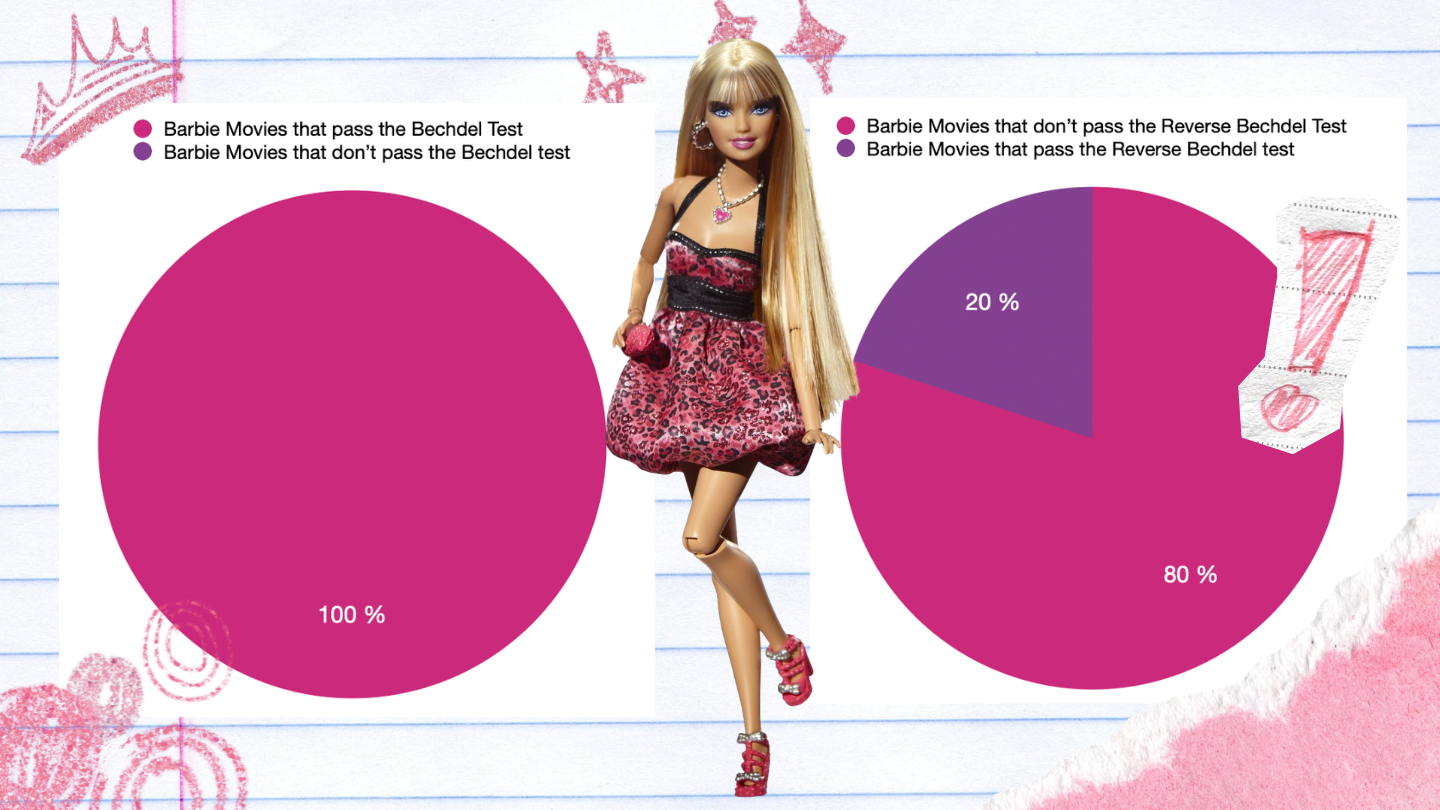
That’s as good as it gets. In a Barbie film the women talk about anything, and the men barely exist outside of her story. Which is exactly the reverse of what people assume about her. And the reverse of what Hollywood has been doing to women for years.
But let’s be honest, no one watches TV nowadays, everything interesting is on social mediaaaaaa (pls don’t let cinema die, i’m begging you)
Barbie online
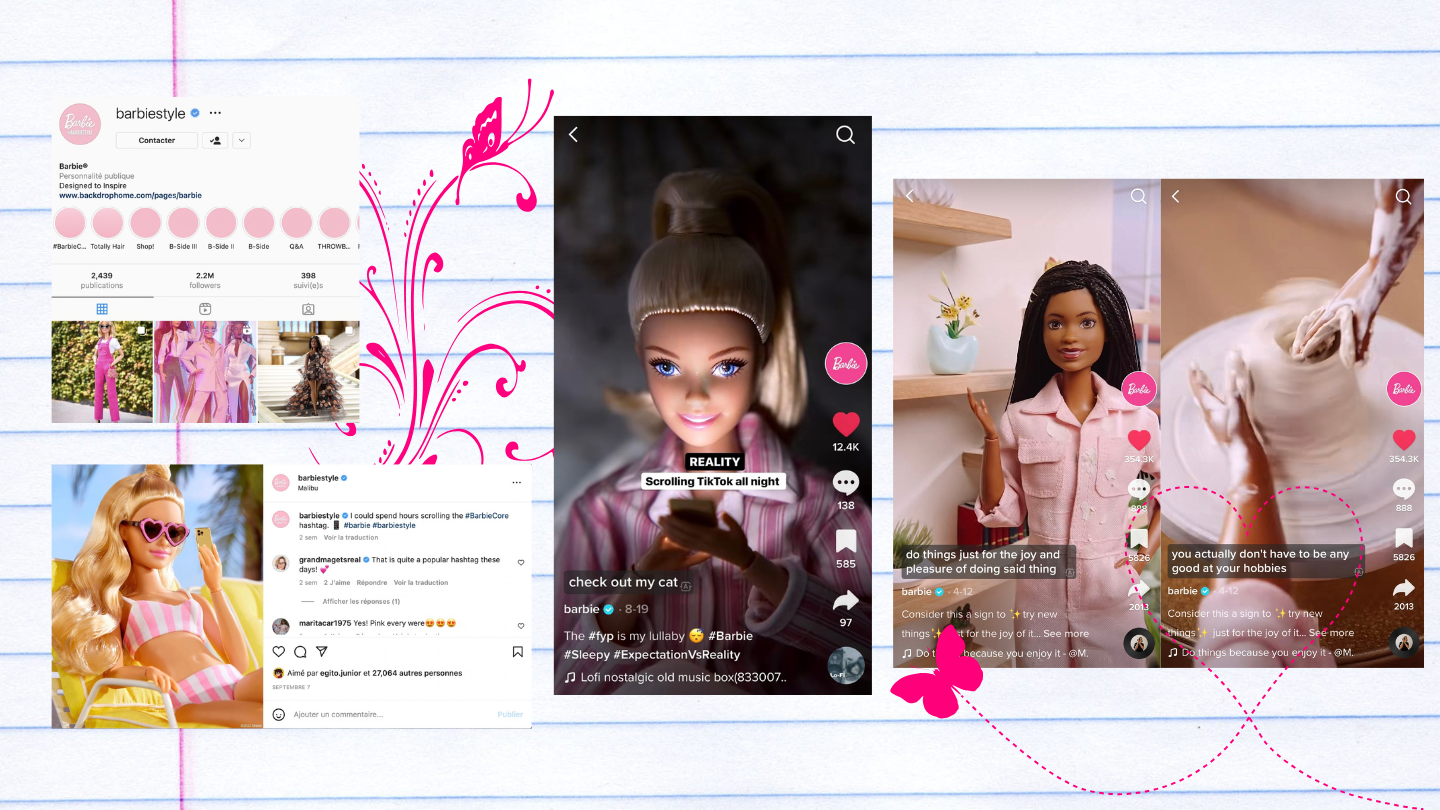
On Instagram (@barbiestyle, about 2.2 million followers back in the day), she is your perfect influencer: fashion, pink, flawless. On TikTok (@barbie), she is your relatable influencer. The videos say things like: you don’t have to be good at your hobbies, do things just for the joy of it. You know, classic cases of a brand trying to match what each platform rewards — but always remaining decent as far as I’m aware. No blatant display of terrible advice for girls. Just Barbie existing as a character who happens to have social media.
But the big one is YouTube, with the Barbie Vlogs. Barbie sits in her room, talks to the camera, and covers many difficult subjects about mental health, but also some genuinely good advice about how to navigate the social life. In more recent ones there were vlogs with other Barbie characters that focused on spreading awareness about different cultures and sensitive topics.
They never had a huge audience. But they tackled subjects that could actually touch teens, more than children. That makes sense: at the time, the YouTube audience was mostly young teens, teens and young adults. There was plenty of fun content too, but one did not prevent the other. And I’ll say it: some of those vlogs genuinely helped me back in the day.
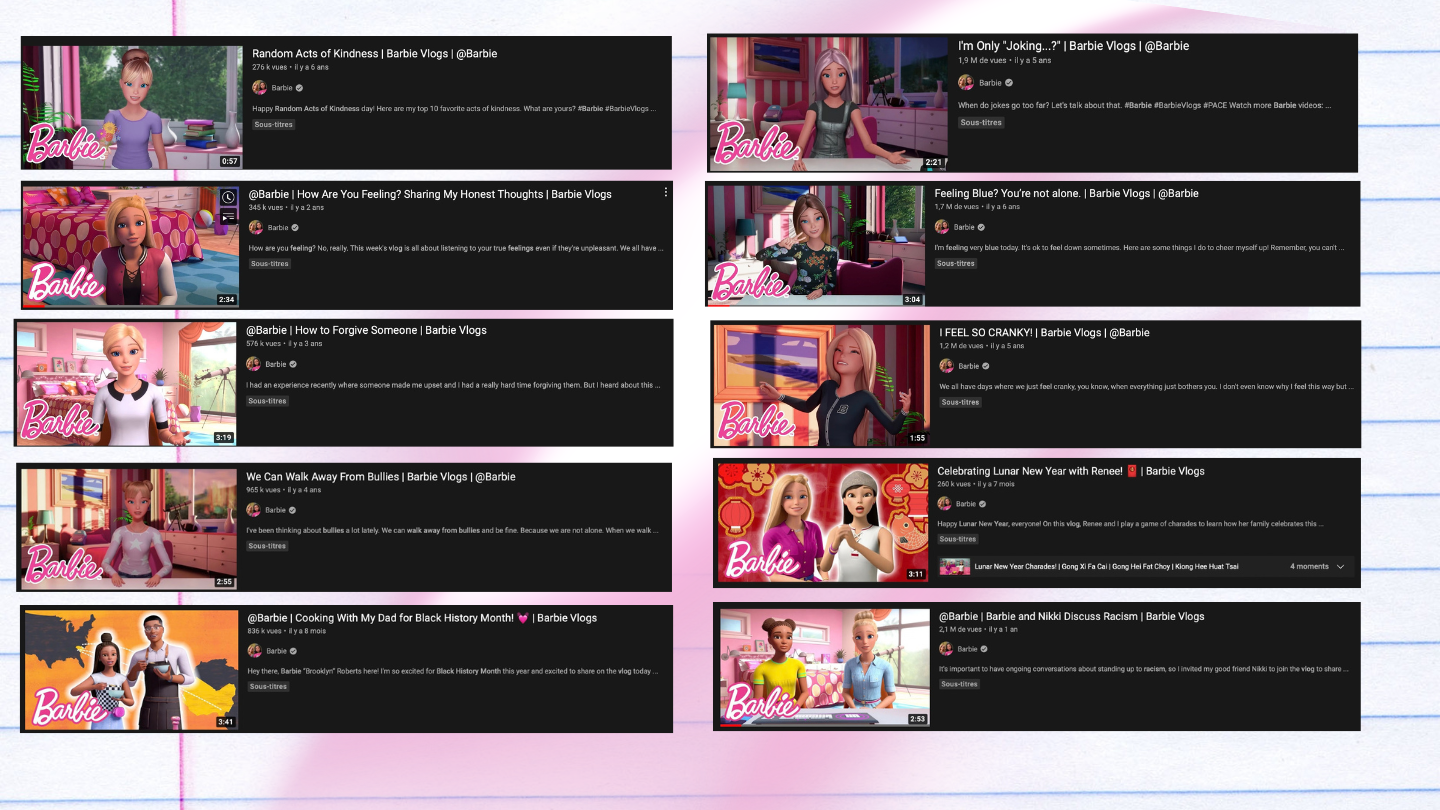
Recently, though, the vlogs opted out of that. The new direction is more colourful and simple, so that it’s accessible to children, who are more and more present on YouTube. You can even see the difference in the comments: they aren’t allowed on videos made for kids, and in her early vlogs Barbie asks the comment section to help her choose an outfit for prom. I’m mourning this. It’s not a direction I’m happy about, but at the same time I feel like a lot of things targeted at younger audiences keep getting watered down and more vibrant. It’s no surprise a brand as big as Mattel followed along.
So what about it?
Can Barbara Millicent Roberts be considered a fitting role model for children?
Well, Barbie the doll can definitely be a good role model, if you’re an educated adult on what she has mostly tried to represent over the years and know about her character through the films. There have been mishaps here and there, and they’re not over. We’ve just seen Teen Talk Barbie, and the watered down vlogs.
But I personally believe most little girls will remember her cool outfits and her bravery, not that she doesn’t look like them — unless a very (not) smart adult decides to point it out to them. Because as a child you know Barbie through two forms, the character in the films (kind, brave, intelligent) and the doll you project your own stories onto. You either control the narrative, or are exposed to kindness. Her physical appearance is never the point of the stories being told. What matters is what she does, and what we make her do when we play.
I know the main criticism of Barbie dolls has been their body. I just cannot speak on the topic because to me, the dolls have always been plastic. I never thought I was meant to look like her or that her body was an accurate representation of what a woman is meant to look like. I mean some of the older ones were so oddly shaped I never even considered it physically possible to look like that. It just never crossed my mind.
Ultimately, faithful to “You can be anything.” Barbie is… Well, she’s doing everything. She is an entity and an object at the same time. She will only be a good role model if you decide to let her be one.
In my eyes, she’s always been a good role model.
What about yours?
Side note:
One more thing about the dolls, because it shows where the marketing went.
Mattel has a collector line called Inspiring Women: Katherine Johnson, Sally Ride, Rosa Parks, Frida Kahlo, Amelia Earhart, Ella Fitzgerald, Billie Jean King and Florence Nightingale. Each one comes with a little profile sheet and fun facts. That’s the classic idea of a role model: someone extraordinary, in a box, to look up to.
Then there are the Fashionistas, which are a very different idea. Different body types, skin tones and hair, a doll with vitiligo, one with a prosthetic leg, one in a wheelchair, one with no hair, a Ken with long hair. Nobody is being held up as an example. They’re just there, looking like real people.
The marketing might not be perfect; but it’s trying.
In Barbie, there will always be a bit of everything for everyone. Maybe not ever a perfect replica of you, but enough versions between the official materials and the parodies for you to identify with it.
want these landing in your inbox before anyone else sees them?
subscribe to the newsletter on substack
you’ll get every article 3 days early, and you can choose to only hear about book updates if that's more your thing.
If you’d like to support me you’re welcome to leave a little something in the tipping jar below